AI-Automated Scan-to-BIM: When Point Clouds Classify Themselves
Turning a laser scan into a model has always been slow, manual tracing. Machine learning is starting to do the hardest part — recognising what each point belongs to.
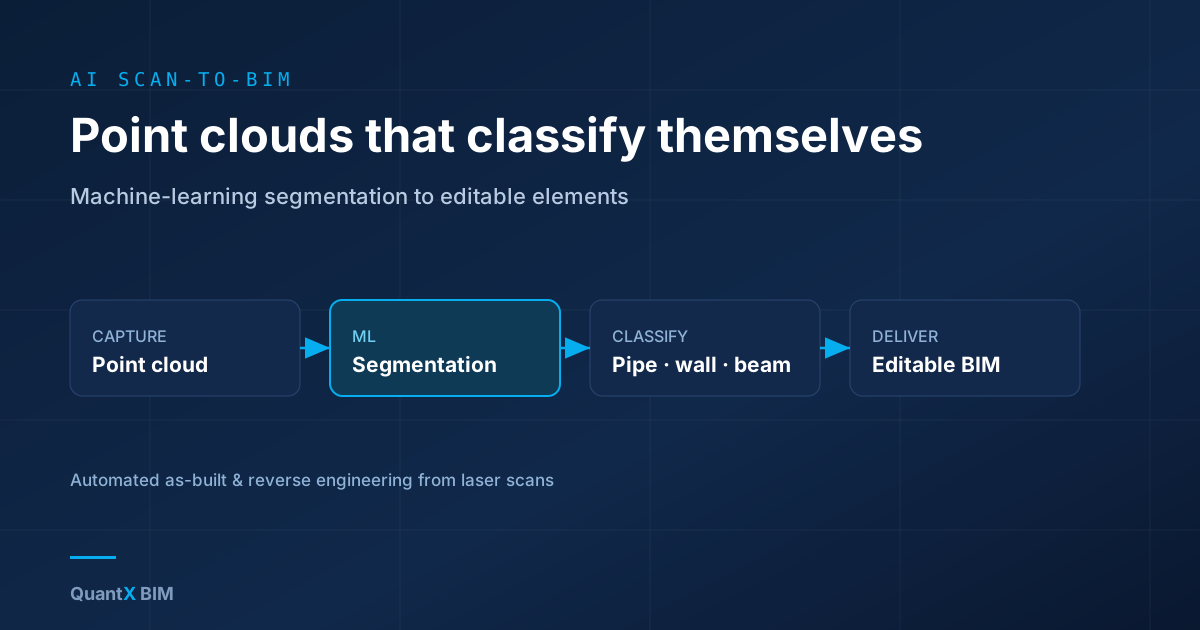
Scan-to-BIM has a dirty secret: the scanning is the easy part. A modern laser scanner captures a building or a plant as tens or hundreds of millions of points in hours. Turning that dense, undifferentiated cloud into a usable model — deciding that this cluster of points is a wall, that one a pipe, another a beam — has traditionally been slow, manual and expensive. This is exactly the step machine learning is now transforming.
The Bottleneck Was Never the Scan
A point cloud is just coordinates. It has no idea that one region is structural steel and another is a duct. A modeller supplies that meaning by hand, tracing geometry element by element — the part of the process that consumes most of the time and cost. Speed up capture all you like; the modelling remains the constraint.
What Machine Learning Adds
ML models trained on labelled scans can perform semantic segmentation: classifying each point or cluster as a category — wall, floor, pipe, beam, valve — and separating objects from one another. Once points are classified, downstream automation becomes tractable: fitting primitives to a pipe run, extracting a wall's planes, or proposing an editable element the modeller can accept or adjust. The human shifts from tracing everything to reviewing and correcting, which is far faster.
Where It Works Best Today
- Repetitive, geometric environments. Industrial plants full of pipes and structural frames, or regular building interiors, suit automated classification well.
- As-built and reverse engineering. Capturing existing conditions for renovation, or reconstructing an undocumented facility, is where the manual cost has always been highest — and the automation payoff largest.
- Assisted, not unattended. The reliable pattern is AI-assisted: the machine proposes, a human verifies. Full lights-out scan-to-BIM on messy real-world data is not here yet.
The Practical Takeaway
If you deal in existing assets — refurbishments, retrofits, industrial facilities — this is the development to watch, because it attacks the single most expensive step in the whole reality-capture pipeline. The goal is not to remove the engineer but to stop paying skilled people to trace points, freeing them to make the judgement calls a model actually needs. As segmentation keeps improving, the distance between a scan and a trustworthy, editable model keeps shrinking — and the economics of capturing the built world as data keep getting better.
References
- ASTM E2807 — Standard Specification for 3D Imaging Data Exchange (E57) — ASTM International
- Level of Accuracy (LOA) Specification — U.S. Institute of Building Documentation
- AI Risk Management Framework — NIST
- Industry Foundation Classes (IFC) — buildingSMART International