IDS: Turning BIM Requirements Into Checks the Model Can Answer
Information requirements have long been written in prose nobody could verify. The Information Delivery Specification makes them machine-readable — and automatically checkable.
Every BIM project sets out what information it needs — which objects, with which properties, to what level, at which stage. For years those requirements lived in prose: PDFs and spreadsheets that a human had to read, interpret and then manually verify against a model. It was slow, subjective and easy to fudge. buildingSMART's Information Delivery Specification (IDS) changes that by making requirements something a computer can read and check.
The Problem IDS Solves
Under ISO 19650, a client issues Exchange Information Requirements — the "what we need and when." But a requirement like "all fire doors shall carry a fire rating and a certification reference" is only useful if someone actually verifies it. On a model with tens of thousands of objects, manual checking is impractical, so it often does not happen, and information gaps surface late — at handover, when they are most expensive to fix.
How IDS Works
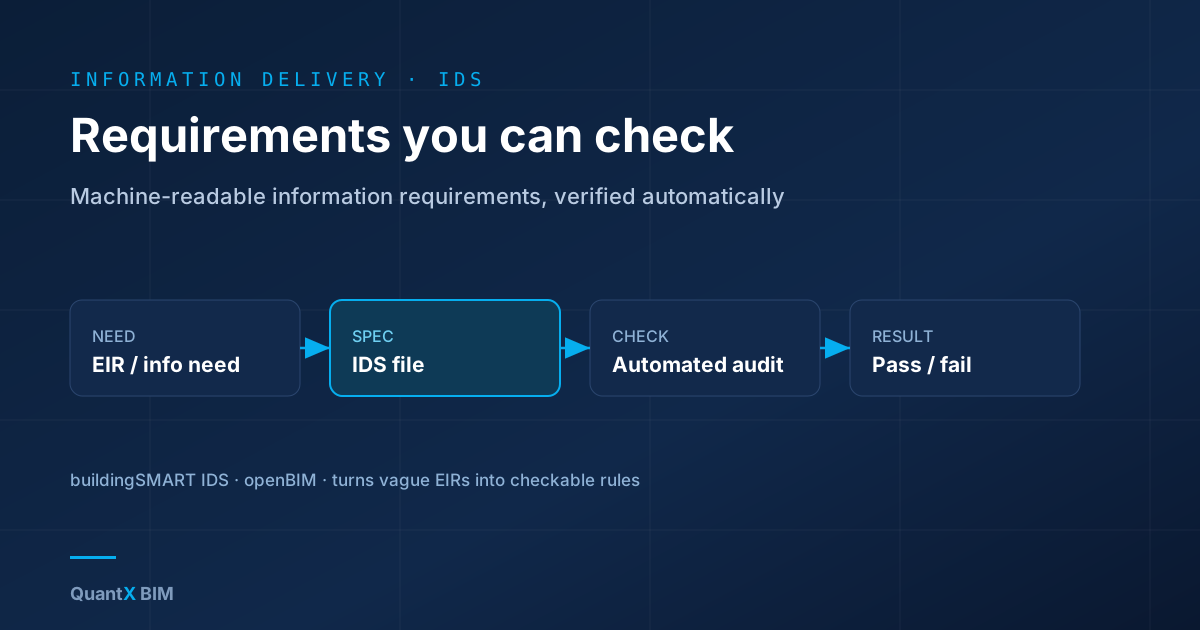
IDS is a simple, open standard that expresses requirements as machine-readable rules: for a defined set of objects (by class, type or classification), it states which properties must be present and what values or datatypes are acceptable. Because it is openBIM and vendor-neutral, an IDS file can be applied against an IFC model in any compliant checking tool. The output is not an opinion; it is a pass/fail report showing exactly which objects meet the specification and which do not.
Why This Is a Big Deal
- Requirements become testable. The same file that specifies what is needed can be used to verify it — no translation, no ambiguity.
- Checking becomes continuous. Teams can run IDS checks throughout delivery, catching gaps while they are cheap to fix rather than at handover.
- Trust improves. Owners get objective evidence that a model meets their information requirements, not a promise that it does.
Where to Start
Begin by turning your most important, most often-missed requirements into a small IDS — the properties that genuinely matter downstream for cost, operations or compliance. Share it at the start of a project so the delivery team designs to a target they can test against, and build the check into your regular model-QA routine. IDS will not write your information requirements for you, but it finally makes them enforceable. In an industry that has long treated "information deliverables" as the softest part of BIM, that is a quietly radical step.
References
- Information Delivery Specification (IDS) — buildingSMART International
- ISO 29481-1:2016 — Building information models — Information delivery manual, Part 1: Methodology and format — ISO
- buildingSMART Data Dictionary (bSDD) — buildingSMART International
- ISO 19650-2:2018 — Information management using BIM, Part 2: Delivery phase of the assets — ISO
- Industry Foundation Classes (IFC) — buildingSMART International