IFC 4.3 and IFC 5: The Next Chapter of openBIM
IFC 4.3 has become an ISO standard and finally reaches infrastructure, while IFC 5 promises a deeper re-architecture. Here is what is changing and why it matters.
For most of its life, IFC — the open, vendor-neutral data schema at the heart of openBIM — has been a building format. It described walls, slabs, doors and ducts extremely well, and roads, rail and bridges hardly at all. That gap is now closing, and the change is one of the most consequential BIM developments in years. IFC 4.3 has become an international standard, and a far more ambitious IFC 5 is taking shape behind it.
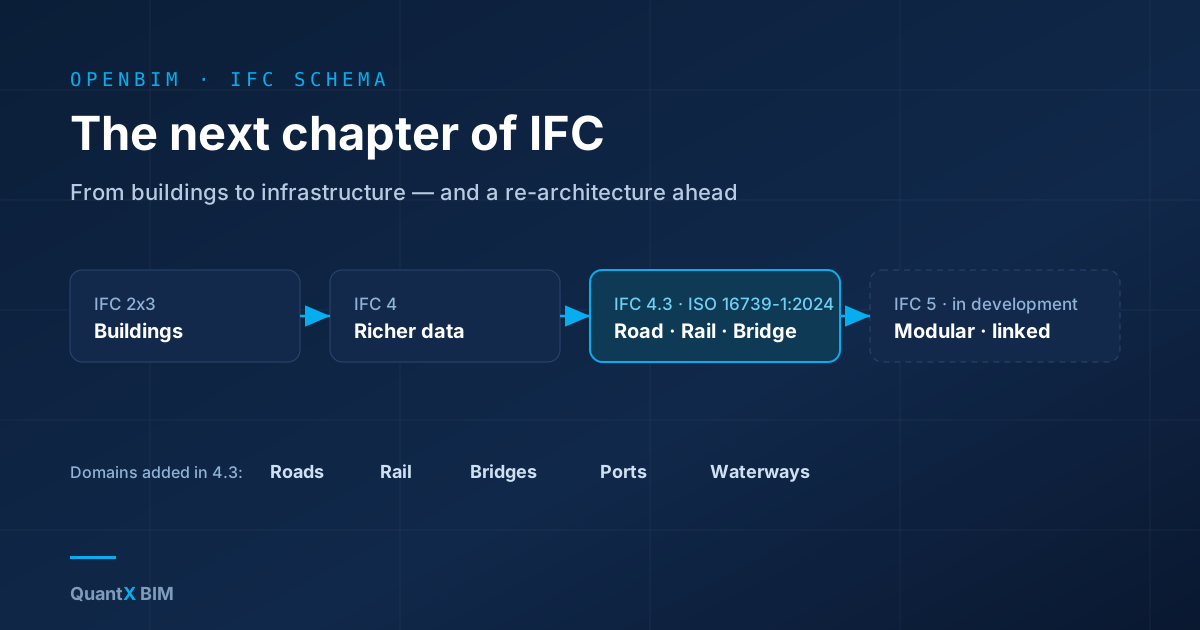
What IFC 4.3 Actually Adds
IFC 4.3 was published by buildingSMART and adopted as ISO 16739-1:2024, giving it the weight of a formal international standard. Its headline contribution is infrastructure: the schema now models linear assets — roads, railways, bridges, ports and waterways — using alignment as a first-class concept. Instead of forcing a motorway or a metro line into a building-shaped data model, teams can describe geometry along a chainage, with cross-sections, earthworks and corridor elements that civil engineers actually recognise.
For any firm working on transport or civil projects, this is the difference between exchanging real coordinated data and exporting a lossy approximation. It also aligns openBIM with the way infrastructure owners increasingly write their information requirements.
Why IFC 5 Is a Bigger Deal Than a Version Bump
IFC 5 is still in development and should be treated as a direction of travel rather than a shipping standard. But its ambition is significant: a modular re-architecture that moves IFC away from a single monolithic file toward a more granular, linked and layered data model. Concepts borrowed from modern data and graphics — composable layers, better geometry, and cleaner separation between geometry and properties — aim to make IFC easier to extend, query and integrate with other systems.
The practical promise is a schema that behaves less like a document you export once and more like a database you can connect to. That fits the wider industry shift from file-based exchange to data-centric workflows.
What It Means for Your Projects
- Infrastructure teams should start specifying IFC 4.3 where owners and tools support it, and confirm that their authoring platforms export alignment-based geometry rather than flattening it.
- Building teams gain little from 4.3 directly but benefit from the momentum: better tooling, clearer certification, and a healthier openBIM ecosystem.
- Everyone should watch IFC 5 without waiting for it. Design your information requirements around openBIM principles now, and the transition will be evolutionary rather than disruptive.
The Bigger Picture
The quiet lesson of IFC 4.3 and IFC 5 is that openBIM is maturing from a building-exchange format into the connective tissue of the whole built environment — vertical and horizontal, design and operation, file and database. Interoperability was always the point; these releases make it credible across far more of the industry. The firms that treat IFC as a strategic capability, not a checkbox on export, will be the ones ready when the next chapter ships.
References
- IFC Schema Specifications — buildingSMART International
- ISO 16739-1:2024 — Industry Foundation Classes (IFC) for data sharing, Part 1: Data schema — ISO
- Industry Foundation Classes (IFC) — buildingSMART International
- openBIM — buildingSMART International
- buildingSMART Data Dictionary (bSDD) — buildingSMART International