Material Passports and the Golden Thread: Data That Outlives the Building
Buildings are becoming material banks and safety-critical assets at once. Material passports and the golden thread make the data travel with them — from product to reuse.
A building is two things at once that the industry is only now learning to treat seriously: a future bank of materials, and a safety-critical asset whose information must never be lost. Both demand the same thing — reliable data that travels with the building through its whole life. Two ideas gaining real momentum, material passports and the golden thread, are how that data is being made to persist.
Material Passports and the Circular Economy
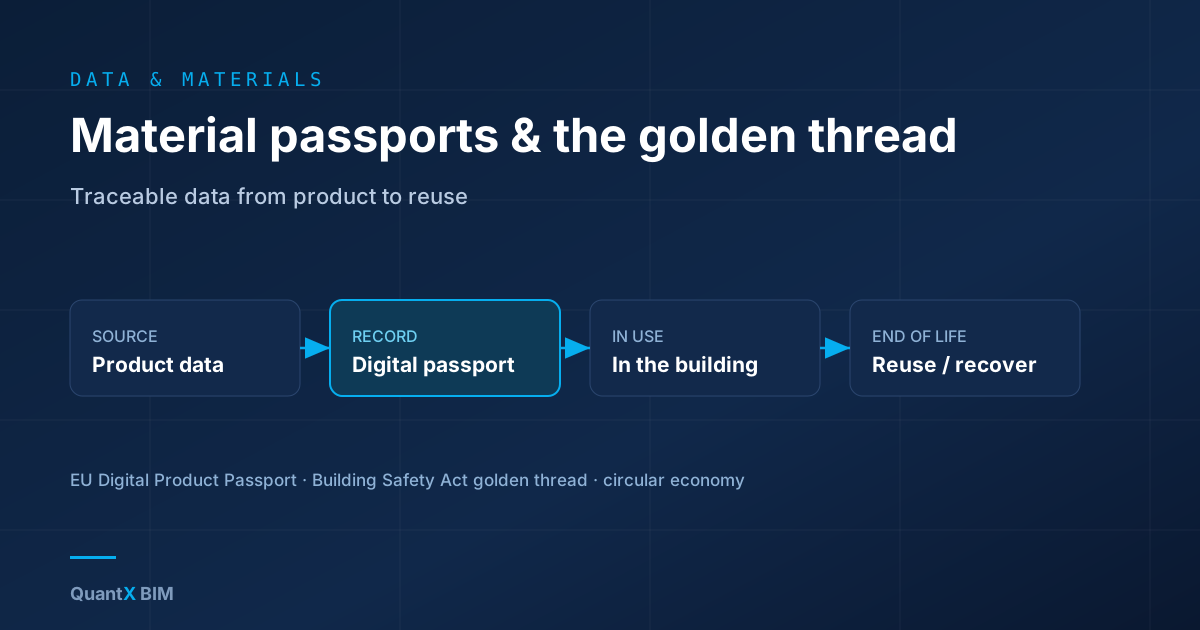
Construction consumes a vast share of the world's raw materials and generates a huge share of its waste, largely because at demolition nobody knows what a building is made of. A material passport fixes that: a structured record of the materials and products in an asset — what they are, where they are, their quantities and their properties — so that at end of life they can be recovered and reused rather than crushed to rubble. The building becomes a documented material bank, which is the practical foundation of a circular economy in construction.
The Digital Product Passport
Regulation is now pushing this from good intention to requirement. The European Union's Digital Product Passport, arriving across product categories including construction products, will require manufacturers to attach standardised, digital data to what they sell — composition, environmental impact, and recyclability. For the built environment that means the raw material for building-level passports increasingly arrives with the product itself, rather than having to be reconstructed later.
The Golden Thread
Running alongside is the golden thread of information — a concept crystallised by building-safety reform, notably the UK's Building Safety Act after Grenfell. The principle is that safety-critical information about a building must be accurate, accessible and maintained across its entire life, so that the people responsible always know how it was designed, built and changed. It reframes information management as a safety obligation, not a paperwork exercise.
Where BIM Fits
- The model is the container. A well-structured BIM model is the natural home for both material data and the golden thread — object by object, with properties attached.
- Data quality is the whole game. A passport or thread is only as good as the information in it; discipline at design and construction is what makes it trustworthy decades later.
- Handover is the moment of truth. The value is realised only if this data survives handover into operation — the step the industry has historically been worst at.
Material passports, digital product passports and the golden thread point at the same future: a building whose data is as durable as its structure, serving sustainability and safety at once. For an industry that has treated information as disposable, learning to make it last may be the most important development of all.
References
- Keeping information about a higher-risk building: the golden thread — UK Government
- Independent Review of Building Regulations and Fire Safety: final report — UK Government
- Circular Economy in the Built Environment — Ellen MacArthur Foundation
- ISO 20887:2020 — Design for disassembly and adaptability: principles, requirements and guidance — ISO
- buildingSMART Data Dictionary (bSDD) — buildingSMART International