OpenUSD and Real-Time Engines: BIM Steps Into the Live Model
Game engines and a format born in film are reshaping how the built environment is visualised, reviewed and operated — in real time. Meet OpenUSD and its role in AEC.
Some of the most powerful tools arriving in architecture and construction were not built for it. Real-time game engines and OpenUSD — a scene format born in visual effects — are quietly changing how the built environment is visualised, reviewed and operated. The static, wait-for-the-render world of design review is giving way to something live.
What OpenUSD Is
OpenUSD (Universal Scene Description) began at Pixar as a way to assemble enormous 3D scenes from many contributors and tools without everything grinding to a halt. Its superpower is composition: many layers of geometry and data from different sources can be combined non-destructively into one coherent scene. That is a strikingly good fit for AEC, where a project is exactly that — many disciplines' models that must come together. Backed by a broad industry alliance, OpenUSD is emerging as a neutral exchange and assembly layer for large 3D worlds.
Why Real-Time Engines Matter Here
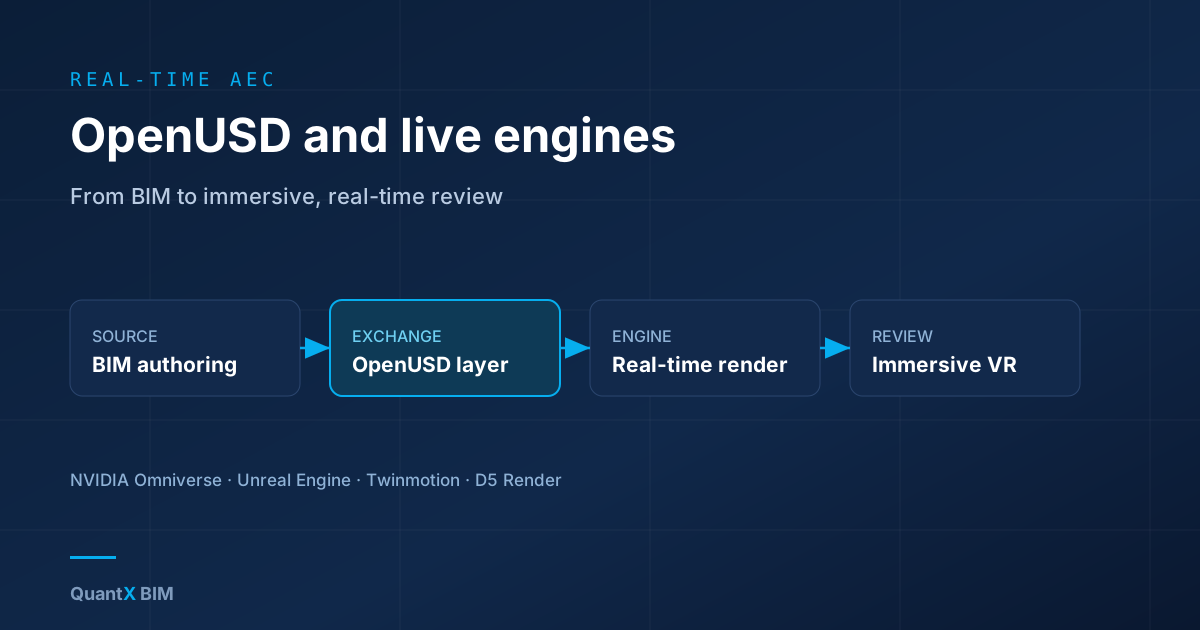
Engines like NVIDIA's Omniverse and Epic's Unreal — along with AEC-focused tools such as Twinmotion and D5 Render — bring photoreal, interactive rendering to design. Instead of waiting hours for a still image, teams walk through a space live, change materials and lighting on the fly, and review options together. The same real-time capability underpins immersive VR review, where stakeholders stand inside a model at full scale before anything is built.
Beyond Pretty Pictures
- Better decisions, sooner. Clients understand a space they can walk through far better than a drawing, so design intent is agreed earlier and changed less late.
- Coordination and simulation. A composed, real-time scene is a natural place to review clashes, sequence construction (4D), and rehearse logistics.
- The living digital twin. The same real-time, data-rich environment that renders a design can, fed with live sensor data, become an operational digital twin after handover.
The Takeaway
The line between BIM authoring, visualisation and operation is blurring. OpenUSD provides a common way to assemble the pieces; real-time engines provide the live, immersive environment to experience them. For firms, the practical move is to stop treating visualisation as a one-off deliverable and start treating the real-time model as a continuous medium for design review, coordination and — eventually — operation. The model is no longer a thing you render; it is a place you can step into while it is still being designed.
References
- The Alliance for OpenUSD (AOUSD) — Alliance for OpenUSD
- Universal Scene Description documentation — OpenUSD
- Omniverse Libraries — NVIDIA
- Industry Foundation Classes (IFC) — buildingSMART International