An honest answer. QuantX Ops suits a growing company that has outgrown spreadsheets but cannot absorb a six-figure ERP. It is a poor fit for two-person outfits and for enterprises with a dedicated ERP team.
Software marketing usually claims to suit everybody. That claim costs the reader time and
costs the vendor a refund, so here is a narrower and more useful answer.
QuantX Ops fits you if…
You are between 20 and 500 people. Below that, spreadsheets genuinely
are cheaper. Above it, you probably already have an ERP team and a set of integrations you
are not going to abandon.
You deliver work against customer orders. Projects, work orders,
milestones, retentions, part billing. If you sell a product off a shelf, half of QuantX Ops
does not apply to you.
Your finance and delivery teams disagree about numbers. That is the
single clearest symptom that the quote, the order and the invoice live in different files.
You are GST-registered in India — or are explicitly not, which QuantX Ops
also handles, rather than assuming.
You have nobody to run an implementation. A new company gets its chart
of accounts, document numbering, approval workflows and HR masters on day one; setup is
mostly telling it about your people and customers.
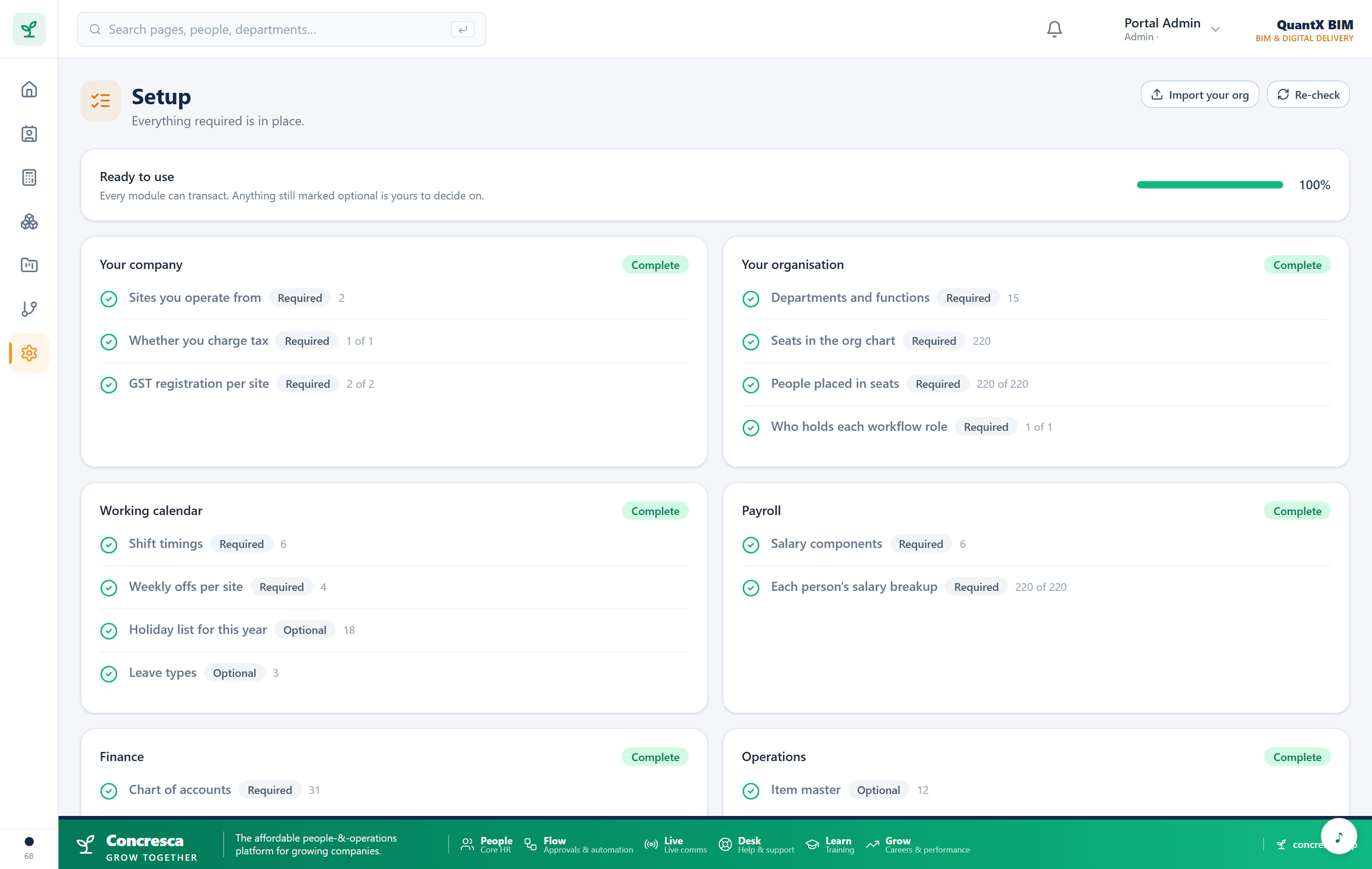
The Setup checklist — what a new company still needs, counted fresh every time it loads
QuantX Ops is a poor fit if…
You are two people. Genuinely: use a spreadsheet and an accountant. The
overhead of any system exceeds the benefit until several people need the same figure.
You need deep manufacturing. There is stock, procurement, a bill of
materials and moving-average valuation. There is no shop-floor scheduling or MRP run.
You have heavy bespoke process already automated elsewhere. QuantX Ops is
opinionated. It will ask you to work its way in places.
You need a public API for everything. Integration surface is deliberately
narrow today.
The industries it was built around
It grew up inside a BIM and digital-delivery business, so construction, engineering
consultancy, architecture and scan-to-BIM bureaux are where the fit is tightest — those are
project-and-milestone businesses with stock, site locations and heavy approval traffic. But
nothing in it is construction-specific. A services firm, a fabricator or an IT consultancy
runs the same thread.